The Workforce Behind America’s Energy Future
It’s people.
Artificial Intelligence (AI), advanced manufacturing, and America’s growing demand for reliable electricity are reshaping the energy industry faster than any time in recent history. While much of the conversation centers on new technologies, one critical factor is often overlooked: the workforce required to bring these projects to life.
This Talascend - Thought Leadership edition explores the talent strategies, workforce challenges, and industry trends that will determine whether the next generation of energy infrastructure is delivered on time, on budget, and with specialized expertise these complex projects demand.
For the better part of two years, nearly every conversation surrounding artificial intelligence has focused on one question:
Where will all the power come from?
It’s an important question. AI workloads, hyperscale data centers, semiconductor manufacturing, and the electrification of industry are driving electricity demand at a pace few predicted just a decade ago. Utilities are reassessing long-term generation plans, technology companies are investing directly in power infrastructure, and advanced nuclear has reemerged as a cornerstone of America’s energy future.
Yet in conversations with engineering firms, utilities, EPC contractors, reactor developers, and technology companies, another challenge consistently rises to the surface:
Who is going to build it?
The greatest risk to America’s next generation of energy infrastructure isn’t simply generating enough electricity. It’s securing a skilled workforce capable of designing, engineering, constructing, commissioning, operating, and maintaining these increasingly complex facilities.
That workforce challenge deserves far more attention.
AI Is Creating an Infrastructure Boom Unlike Anything We’ve Seen
Artificial intelligence isn’t just changing software. It’s fundamentally reshaping America’s physical infrastructure.
The rapid growth of AI, cloud computing, advanced manufacturing, and hyperscale data centers is creating unprecedented demand for continuous, reliable electricity. Facilities that once consumed tens of megawatts are now being planned at several hundred megawatts … and in some cases, more than a gigawatt of continuous power.
Meeting this demand will require an all-of-the-above energy strategy, combining natural gas, renewables, transmission expansion, energy storage, and a renewed focus on nuclear generation.
For executives across the energy sector, this isn’t simply another market cycle. It’s one of the largest infrastructure buildouts in decades.
Why Advanced Nuclear Has Returned to the Conversation
Not long ago, many viewed nuclear energy as yesterday’s technology. Today, it’s becoming one of tomorrow’s most strategic investments.
Advanced nuclear technologies (including Small Modular Reactors (SMRs) and next-generation reactor designs) offer the reliable, carbon-free baseload generation needed to complement renewable energy and support the around-the-clock power requirements of AI-driven infrastructure.
SMRs, in particular, are drawing outsized attention for a simple reason: they change the economics of nuclear power. Because they’re factory-built rather than constructed entirely on site, SMRs carry a smaller physical footprint, lower capital risk, and considerably faster deployment timelines than traditional plants, while incorporating passive safety systems designed to shut down safely with little or no operator intervention.
Beyond SMRs, a broader family of advanced reactor designs (sodium-cooled reactors, molten salt reactors, high-temperature gas reactors, and microreactors) is moving from concept to construction. Many of these designs are inherently safer than legacy plants by virtue of their physics and materials, not just their engineering controls, which is reshaping how regulators, investors, and the public are evaluating nuclear’s role in the energy mix.
Federal investment, utility planning, reactor innovation, and private capital are accelerating development. Technology companies are also exploring long-term nuclear partnerships as they look to secure reliable energy for future data center expansion.
The momentum is undeniable. But technology alone won’t determine success.
The Investment AND the Builders are Already Here
The capital is moving quickly. Reactor developers including TerraPower, Deep Fission, Kairos Power, X-energy, Terrestrial Energy, NuScale, Oklo, Holtec, Aalo Atomics, GE Hitachi, and Westinghouse are advancing designs toward licensing and construction. Engineering and EPC firms such as Bechtel, Fluor, Kiewit, Sargent & Lundy, Burns & McDonnell, Zachry, and Jacobs are positioning to build them. Utilities including TVA, Duke Energy, Dominion Energy, and Southern Company are incorporating advanced nuclear into long-range generation plans.
At the same time, some of the world’s largest technology companies (including Microsoft, Amazon, Google, Meta, and Oracle) are pursuing long-term power purchase agreements and exploring behind-the-meter generation to secure carbon-free, around-the-clock power for AI infrastructure.
Government support is compressing timelines that once took a decade: NRC modernization efforts, DOE funding, loan guarantees, tax incentives, federal executive actions, defense-related applications, and state-level programs are all accelerating deployment in parallel.
Every one of these organizations is competing for the same finite pool of experienced talent.
The Real Bottleneck Is Talent
Building an advanced reactor is one challenge, but building the workforce to deliver it may be even harder.
Across the industry, organizations are facing the convergence of several workforce realities:
- A large portion of the experienced nuclear workforce is nearing retirement.
- Competition for engineering talent has intensified across energy, semiconductor manufacturing, and technology.
- Universities are not producing enough graduates in specialized engineering disciplines to replace experienced professionals at the pace demand is growing.
- Major capital projects are increasingly competing for the same engineers, project managers, schedulers, construction leaders, quality professionals, and skilled trades.
These aren’t isolated hiring challenges. They’re strategic business risks.
A delayed hire can become a delayed project milestone. A shortage of experienced quality professionals can impact commissioning schedules. Limited access to project controls specialists can affect cost certainty and delivery timelines.
Talent availability has become a critical component of project execution.
Workforce Strategy Is Becoming a Competitive Advantage
Historically, many organizations viewed recruiting as a function that began once projects received final approval.
That approach is becoming increasingly difficult to sustain.
Leading organizations are integrating workforce planning much earlier … forecasting labor demand during project development, identifying critical skill gaps, and building talent pipelines well before peak hiring begins.
This proactive approach helps reduce schedule risk, improve hiring quality, and create greater workforce continuity throughout the project lifecycle.
In today’s market, workforce planning isn’t simply an HR initiative. It’s becoming a competitive advantage.
The Future of Energy Will Be Built by More Than Engineers
The conversation often centers on engineers, but successful projects require expertise across the entire project lifecycle. Organizations are competing for talent across every phase of delivery:
- Engineering: Mechanical, Nuclear, Civil, Structural, Electrical, Instrumentation & Controls, And Process Engineers
- Project Delivery: Project Managers, Schedulers, Cost Engineers, Procurement Specialists, and Contract Managers
- Quality: QA/QC Professionals, Supplier Quality Specialists, Welding Inspectors, and NDE Experts
- Construction: Construction Managers, Field Engineers, Superintendents, And Skilled Trades Including Electricians, Pipefitters, Ironworkers, Millwrights, and Welders
- Commissioning: Commissioning Engineers in Mechanical, Electrical, and I&C
Every discipline represents another piece of the workforce puzzle.
Looking Beyond Today’s Hiring Needs
One of the biggest mistakes organizations can make is treating workforce planning as a reaction to immediate hiring demand.
The companies that will lead the next generation of energy infrastructure are planning years ahead. They’re developing workforce strategies that align with project milestones, anticipating labor market constraints, and partnering with organizations that understand the technical complexity of large-scale capital projects.
As the pace of advanced nuclear deployment accelerates, access to specialized talent will increasingly influence which projects stay on schedule and which fall behind.
How Talascend Helps Close the Gap
Delivering advanced energy projects requires more than engineering excellence … it demands access to highly specialized talent capable of supporting every phase, from early licensing and front-end engineering through construction, commissioning, and long-term operations.
As reactor developers, EPC firms, utilities, and technology companies race to deploy next-generation nuclear facilities, Talascend partners with them across contract staffing, direct hire, executive search, and project-based workforce solutions … helping build the engineering, project controls, quality, construction, and operations teams these projects depend on.
Looking Ahead
- AI will continue increasing electricity demand.
- SMRs will complement renewables and natural gas.
- Advanced reactors will reshape industrial power.
- Workforce development will determine project success.
- Strategic staffing partners will play a critical role in accelerating deployment.
Final Thoughts
America’s energy future will be shaped by innovation, investment, and technology. But it will ultimately be delivered by people.
As our industry prepares for one of the most significant infrastructure expansions in generations, the conversation needs to extend beyond megawatts, reactor designs, and capital investment. We also need to talk about engineers, project managers, skilled trades, and the workforce strategies required to bring these projects to life.
Because while the race for reliable energy is already underway, the race for talent may prove to be the deciding factor.
Reach out to Talascend to learn more about the strategies we can help you with to build your workforce.
About the Author
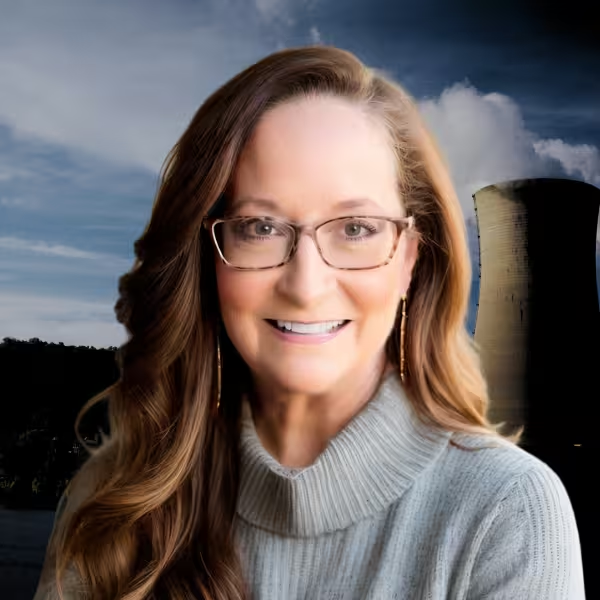
As Senior Vice President at Talascend, Monique Mollere partners with EPC firms, utilities, technology companies, and advanced manufacturing organizations to develop workforce strategies for complex engineering and infrastructure projects nationwide. With strong experience in technical recruitment and workforce planning, Monique provides executive insight into the talent challenges (with proven solutions) that will shape America’s energy future.
About Talascend
Talascend is a specialized talent solutions firm connecting engineering, technical, and skilled trades professionals with the companies building America’s infrastructure, energy systems, defense capabilities, and manufacturing base. With nearly 80 years of industry experience, Talascend serves clients nationwide from its headquarters in Troy, Michigan.
About this Report
This whitepaper draws upon publicly available information from the U.S. Department of Energy (DOE), the Nuclear Regulatory Commission (NRC), the U.S. Energy Information Administration (EIA), national laboratories, industry associations, publicly announced company initiatives, and market analyses to provide an overview of the evolving advanced nuclear landscape and its workforce implications.